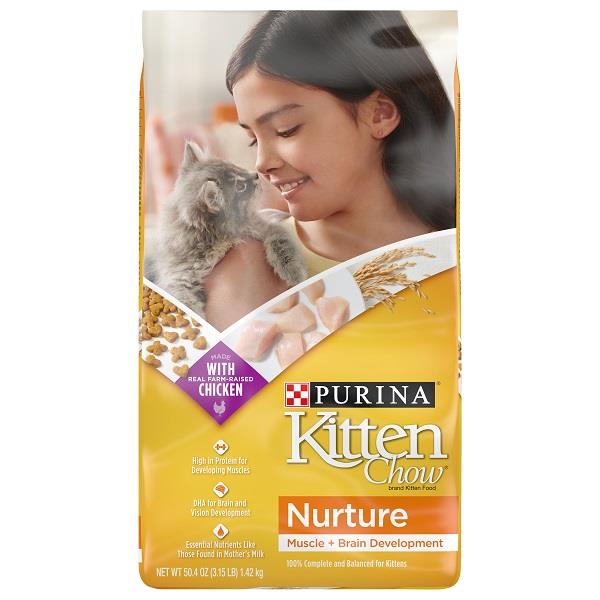
Purina Kitten Chow
- Details
- Nutrition Info
Nutrition Facts
0 servings per container
Serving Size 0
Amount Per Serving Calories | 0 | |
|---|---|---|
| % Daily Value* | ||
| Total Fat 0 | 0% | |
| Saturated Fat 0 | 0% | |
| Trans Fat 0 | 0% | |
| Polyunsaturated Fat 0 | 0% | |
| Monounsaturated Fat 0 | 0% | |
| Cholesterol 0 | 0% | |
| Sodium 0 | 0% | |
| Total Carbohydrate 0 | 0% | |
| Dietary Fiber 0 | 0% | |
| Soluble Fiber 0 | 0% | |
| Insoluble Fiber 0 | 0% | |
| Total Sugars 0 | 0% | |
| Includes 0 Added Sugars | 0% | |
| Protein 0 | 0% | |
| Vitamin D 0 | 0% | |
| Calcium 0 | 0% | |
| Iron 0 | 0% | |
| Potassium 0 | 0% | |
Description
Purina Kitten Chow
Instructions
Store in a cool, dry place. Recommended Daily Feeding Amounts: Age: 3 - 6 weeks; Total Daily Amount: 1/4 to 1/3 cup; Frequency: 3 - 4 times a day. Age: 7 weeks - 6 months; Total Daily Amount: 1/3 to 3/4 cup; Frequency: 3 - 4 times a day. Age: 7 months - 1 year; Total Daily Amount: 1/2 to 3/4 cup; Frequency: 2 times a day. Using a standard 8 oz measuring cup. Feeding Kittens: Kittens generally nibble solid foods at 3 - 4 weeks of age. Keep moistened Purina Kitten Chow Nurture available to these kittens at all times. Just add one part liquid to three parts Purina Kitten Chow Nurture, changing frequently to ensure freshness. After weaning, at 6 - 8 weeks of age, kittens will normally eat dry or moistened food at will. Start a self-feeding program, leaving food in dish at all times. Feeding amounts should be adjusted as necessary to help your kitten maintain an ideal body condition. Because kittens continue to develop throughout their first year, it’s important that they get the extra nutrition of Purina Kitten Chow Nurture for a full 12 months. After one year of age, transition to the Purina Cat Chow formula that’s right for your cat. Feeding for Reproduction: Purina Kitten Chow Nurture provides the extra nutrition needed by reproducing females in stages of gestation and lactation. Food consumption may vary during gestation, so feed the amount needed to maintain the pregnant female’s good body condition. Food intake may double or even quadruple during lactation. Feeding Tip: Changes in your cat’s diet should be made gradually to allow your cat to become accustomed to a new food. Substitute small amounts of the new food for the old food, gradually increasing the amount of the new food while decreasing the old food, over a period of 7 - 10 days. This gradual transition will help avoid dietary upsets. Provide adequate fresh water in a clean bowl daily. For your pet's health, see your veterinarian regularly.
Ingredients
Chicken By-Product Meal, Corn Gluten Meal, Rice, Soy Flour, Beef Fat Preserved with Mixed-Tocopherols, Ground Whole Wheat, Chicken, Fish Meal, Liver Flavor, Dried Yeast, Calcium Carbonate, Phosphoric Acid, Salt, Choline Chloride, Minerals [Zinc Sulfate, Ferrous Sulfate, Manganese Sulfate, Copper Sulfate, Calcium Iodate, Sodium Selenite], Vitamins [Vitamin E Supplement, Niacin (Vitamin B-3), Vitamin A Supplement, Calcium Pantothenate (Vitamin B-5), Thiamine Mononitrate (Vitamin B-1), Riboflavin Supplement (Vitamin B-2), Vitamin B-12 Supplement, Pyridoxine Hydrochloride (Vitamin B-6), Folic Acid (Vitamin B-9), Vitamin D-3 Supplement, Biotin (Vitamin B-7), Menadione Sodium Bisulfite Complex (Vitamin K)], Taurine, Potassium Chloride.
Related Products
Save $3.00 $14.99 11.99 4.5lb ($2.66/lb) Chicken Soup For The Soul Kitten Chicken Brown Rice & Pea